
Q2 FY27
Letter to Investors — September 2026
October 7, 2026

Performance Summary
as of 29 Sep 2026
- NAV (post-fees, pre-tax)
- ₹152.82
- TWRR · 1M
- +3.17%
- TWRR · 3M
- +9.88%
- TWRR · 1Y
- +34.26%
- TWRR · Since inception (annual)
- +15.68%
Performance is calculated using pre-tax NAV on the second-last trading day of the month to avoid quarter-end volatility.
“Interest rates act on financial valuations the way gravity acts on matter: the higher the rate, the greater the downward pull.”
Dear Investors,
A business is worth the cash it will generate, discounted back to today, and the rate used to discount it is anchored to government bond yields. Those yields have come unhinged. In the September quarter the US 10-year Treasury yield closed at 5.26%, matching its 2007 peak, and the 30-year reached 5.59%, its highest in more than two decades. Most of the developed world moved with it, and the global south followed to a lesser degree. When the safe asset pays more, every other financial asset has to compete harder for the same money. That pull, an oil shock with no end in sight, and a very strong El Niño that left the monsoon 13% below normal (the weakest since 2015) all weighed on Indian markets, in a country that imports most of its oil and much of its fertiliser. The Nifty 50 ended the quarter down 5.2% and the Nifty 500 down 4.0%.
Pegasus’ proprietary CEGARP (Capital Efficient Growth at Reasonable Price) framework is built on eight variables. Two of them, long bond yields and global liquidity, sit outside the businesses we own but set the price we pay for them. Both are unsettled, so we discuss them below, with the scenarios we see for the coming year.
During the quarter we raised cash to 8.1% of the portfolio, to be ready for a disorderly adjustment in global bond markets. We sold Welspun Corp after a sharp rise left the price discounting its earnings for FY28 (the year to March 2028) and flawless execution of its growing order book. We added two manufacturing picks and shovels whose earnings are depressed by short-term factors or one-off write-offs: RHI Magnesita India and The Anup Engineering. Both have strong moats and are earning below trend for now, which we expect to recover over the medium term.
The Themes and the Shovels Beneath Them
Ellenbarrie Industrial Gases
- Structural trend
- Capex cycle, coal gasification
- Shovel
- Oxygen, nitrogen and argon from owned air separation units
- P/E at acquisition
- 25x
- ROCE
- 15% (19% ex-IPO cash)
- Net debt
- cash
- Position
- 3.15%
In June we wrote that in coal gasification we prefer the air separation unit, because the gas company owns it on the customer’s fence and sells oxygen on long take-or-pay contracts. Ellenbarrie is how we own that recurring revenue. It runs 11 facilities, mainly in West Bengal, Andhra Pradesh and Telangana, with capacity up from 1,370 tonnes a day in FY25 to about 1,930 tonnes a day in June 2026. On-site plants carry 15 to 20 year take-or-pay contracts, and steel is about 30% of revenue. Nationally it is a challenger: roughly 3% of the market against Linde at 31% and INOX Air Products at 22%.
Last month the company commissioned a 325 tonne-a-day plant for Jai Balaji at Durgapur under a 15-year take-or-pay contract. It also won a ₹481 crore order from Bharat Heavy Electricals (BHEL) to design and build a 1,200 tonne-a-day unit for a coal-to-ammonium-nitrate plant at Jharsuguda, Odisha. This is a construction contract rather than an owned plant, but it gives Ellenbarrie a coal gasification reference that few Indian companies have.
What we’re watching: the BHEL order is 1.4 times last year’s revenue, so fixed-price execution is the near-term risk. Power is the largest input cost, and the West Bengal plants run on grid power. Merchant revenue is not contracted, so it moves with gas prices (argon fell over 25% in one quarter last year). About ₹50 crore of FY26’s ₹104 crore profit was other income, largely interest on cash from the July 2025 initial public offering (IPO). At 25x earnings against a 19% return on capital excluding that cash, we paid above our own valuation line, and the new plants must lift returns to justify it.
RHI Magnesita India
- Structural trend
- China’s anti-involution, turnaround
- Shovel
- Refractory linings and flow-control consumables
- P/E at acquisition
- n.m. (reported loss); ~38x adjusted
- ROCE
- ~7% (goodwill, lower margins)
- Net debt
- net cash (₹140 cr)
- Position
- 4.27%
RHI Magnesita India, majority-owned by the world’s largest refractory group, holds over 30% of the domestic market in refractories and flow-control consumables. About 80% of revenue comes from steel and the balance from the industrial division (non-ferrous metals, glass and cement); about 35% comes from flow-control products. Every tonne of steel India makes wears out refractories: the heat-resistant bricks, castables, slide gates and nozzles that line ladles, converters and tundishes, and are replaced in weeks or months rather than years. Demand tracks steel output, less a slow decline in refractory used per tonne, and India’s steel capacity, about 222 million tonnes a year in June, is targeted to reach 300 million tonnes by 2030. In June we named the refractory that relines a coal gasifier as one of the recurring consumable themes we like. RHI is also our way of owning China’s anti-involution, with an option on India’s rare-earth programme.
China’s anti-involution
China’s Steel Industry Growth Stabilisation Work Plan for 2025-26, issued by five ministries, called for precise control of capacity and output, barred new capacity and pushed weaker mills out. From 1 January 2026 China reinstated export licences on steel for the first time since 2009. Crude steel output fell 4.4% in 2025 and another 3.1% in the first eight months of 2026. For RHI this works twice: less Chinese steel abroad leaves room for Indian mills, which is where its volumes come from, and Beijing’s caps on magnesia capacity should, over time, end the cheap Chinese refractory imports that cut Indian prices last year.
Rare-earth processing
Separating rare earths needs calcining and roasting kilns, and kilns need refractories. RHI has plants in three of the four states the Budget named as rare-earth corridors: Odisha, Andhra Pradesh and Tamil Nadu. There is no rare-earth revenue today, and the volumes would be small next to steel. We treat it as an option, not part of the case.
The reported loss of ₹383 crore is mainly a ₹556 crore goodwill write-down on the acquired Dalmia OCL business. Beneath it, operating cash flow was ₹409 crore, more than twice adjusted profit, the balance sheet is net cash, and the margin on earnings before interest, tax, depreciation and amortisation (EBITDA) recovered to 14.5% in the June quarter, the first quarter of FY27 (Q1 FY27), from 10.8% a year earlier. We are early, and we know it.
What we’re watching: returns are the whole case. On adjusted earnings the stock trades near 38x against a return on capital of about 7%, so it fails our own valuation rule on today’s numbers; we are paying for a recovery in returns. PwC resigned as auditor in August, citing alignment with the parent’s auditor, KPMG. A whistleblower investigation disclosed in FY26 has no published outcome, and a new managing director and chief executive took over in July.
The Anup Engineering
- Structural trend
- Capex cycle, turnaround
- Shovel
- Heat exchangers, reactors and pressure vessels for refining, petrochemicals and power
- P/E at acquisition
- ~35x
- ROCE
- ~19 to 21% (FY26)
- Net debt
- modest (~₹95 cr)
- Position
- 3.70%
Anup builds the heavy process equipment inside refineries, petrochemical complexes and power plants: heat exchangers (54% of FY26 revenue), pressure vessels, reactors and columns, several under licence from Lummus. It holds the American Society of Mechanical Engineers (ASME) U, U2 and R stamps, supplies Reliance, Indian Oil, Saudi Aramco, the Abu Dhabi National Oil Company and NTPC, and won its first nuclear order, for the Nuclear Power Corporation of India’s Kaiga plant, in late 2025. The new Kheda plant can fabricate single pieces of 1,000 tonnes and 8.5 metres in diameter, which puts it in a small club in India.
Revenue and profit are depressed for three reasons: the new Kheda plant’s overheads arrived before its orders, order booking was thin a year ago, and contracts taken in 2025 were priced aggressively. The turnaround shows in orders before profits. Q1 FY27 revenue fell 28.5% and profit was close to zero, but order inflow of ₹315 crore was the highest in the company’s history, the order book reached a record ₹985 crore in August, and the enquiry pipeline is ₹1,100 crore. At the end of September the stock was about 37% below its high.
What we’re watching: operating cash flow was close to zero in both FY25 and FY26 against profits of ₹110 to 118 crore, as receivables rose to ₹416 crore and borrowings to about ₹110 crore. Margins are guided down to about 15% from 21%, below the 18% that CARE Ratings has named as a downgrade trigger. Kheda ran at roughly half capacity last year. At about 35x earnings against a return near 20%, we paid above our own valuation line on depressed earnings; the case rests on margins and cash flow recovering as the order book is executed.
In Focus · Rates and Liquidity
Long-dated yields in developed markets are at multi-decade highs
In September three of the largest central banks raised rates within nine days. The European Central Bank lifted its deposit rate to 2.50%, the Federal Reserve raised its range by a quarter point to 3.75 to 4.00%, its first increase since July 2023, and the Bank of Japan went to 1.25%, its highest since 1995. And yet long yields broke to new highs. The US 10-year closed at 5.26% on 29 September, matching its 2007 peak. The French 30-year has passed its 2008 high. Japan’s 10-year is above 3% for the first time since 1996, and its 30-year above 4% for the first time on record.
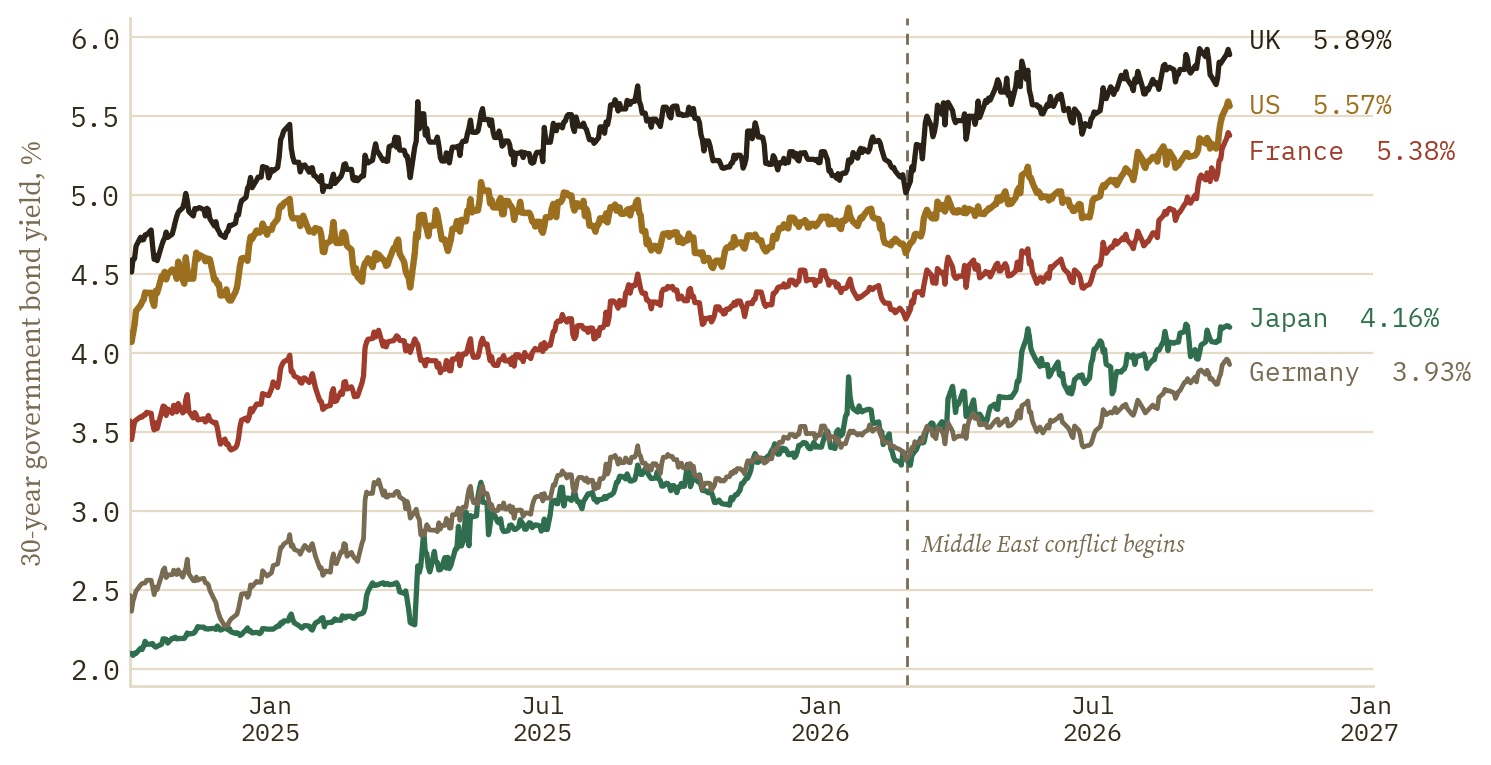
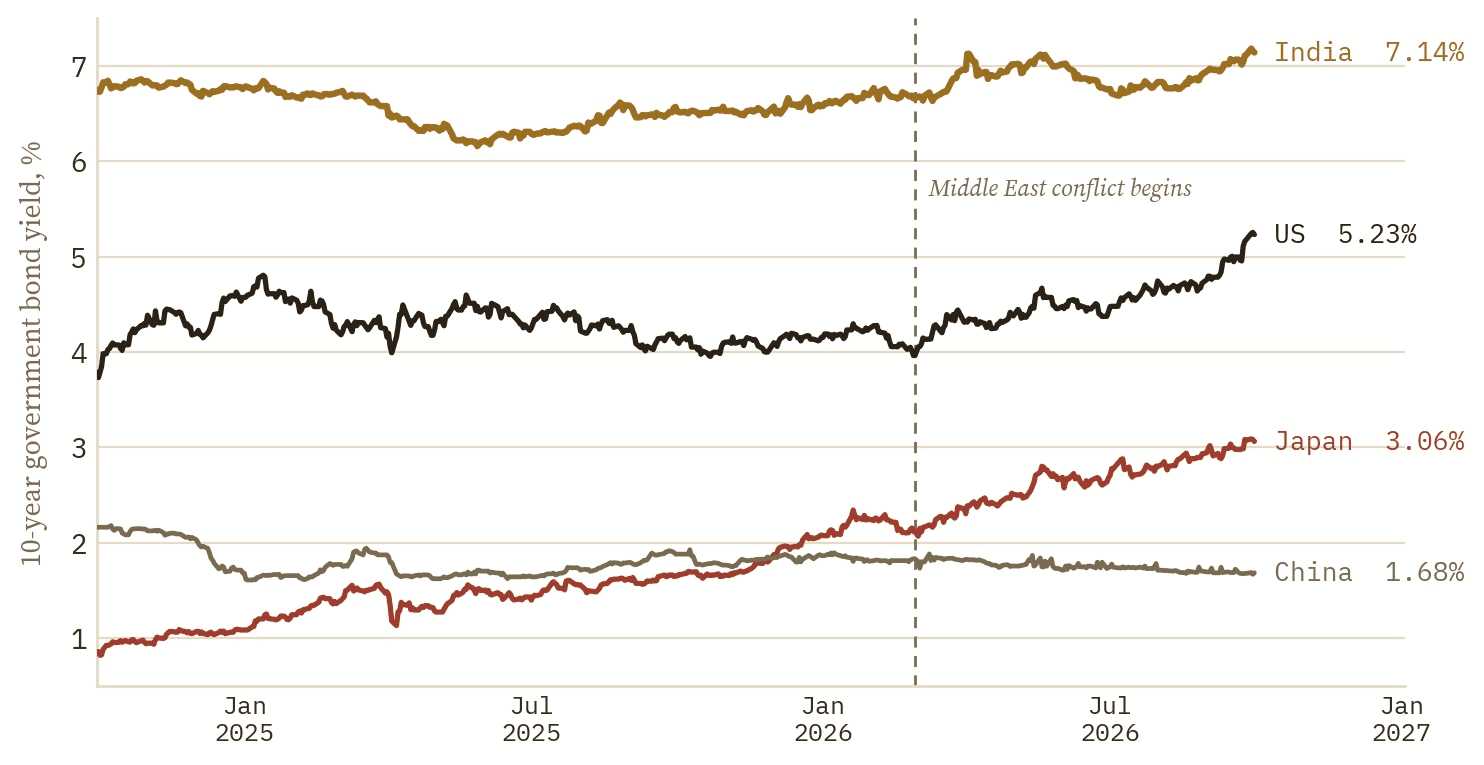
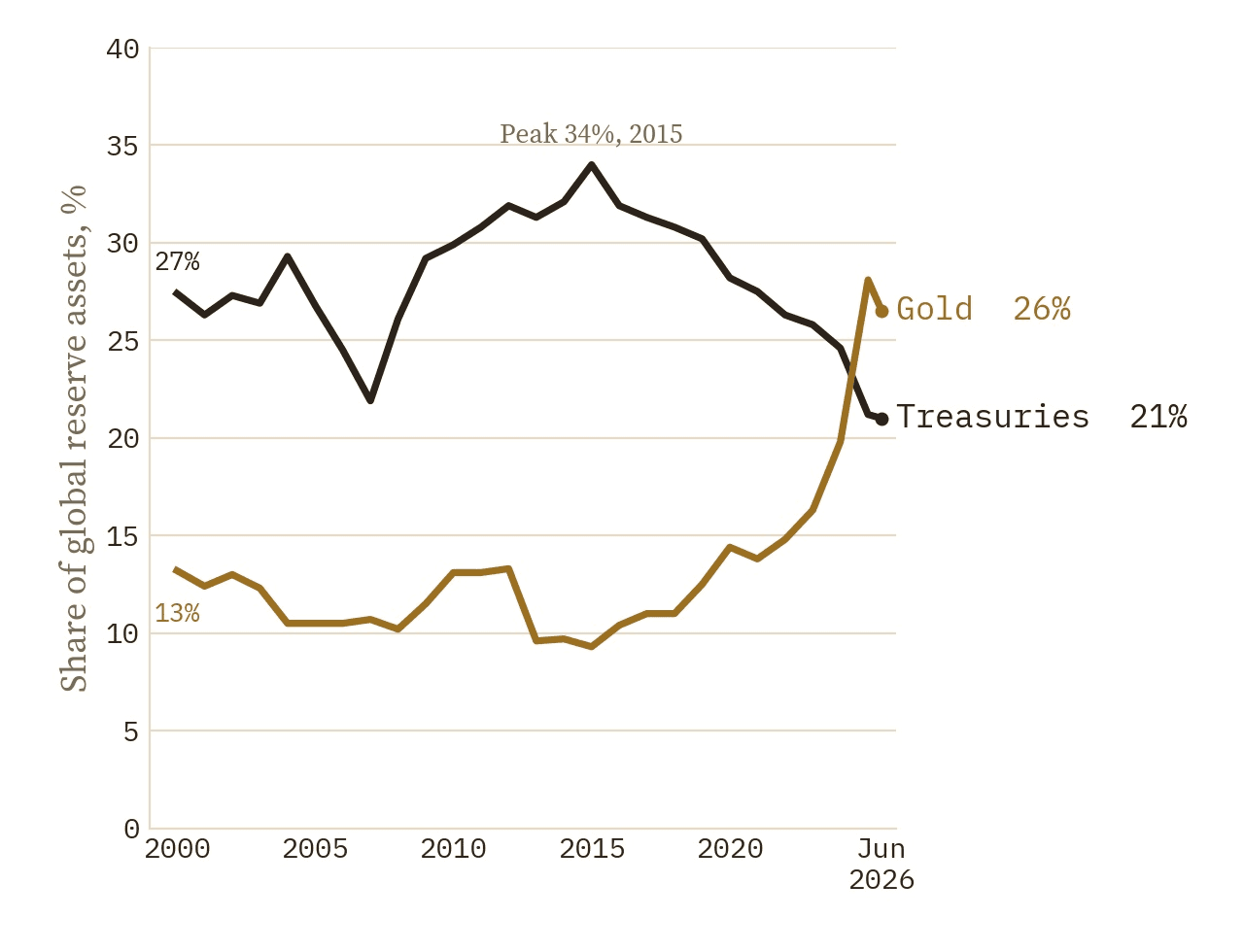
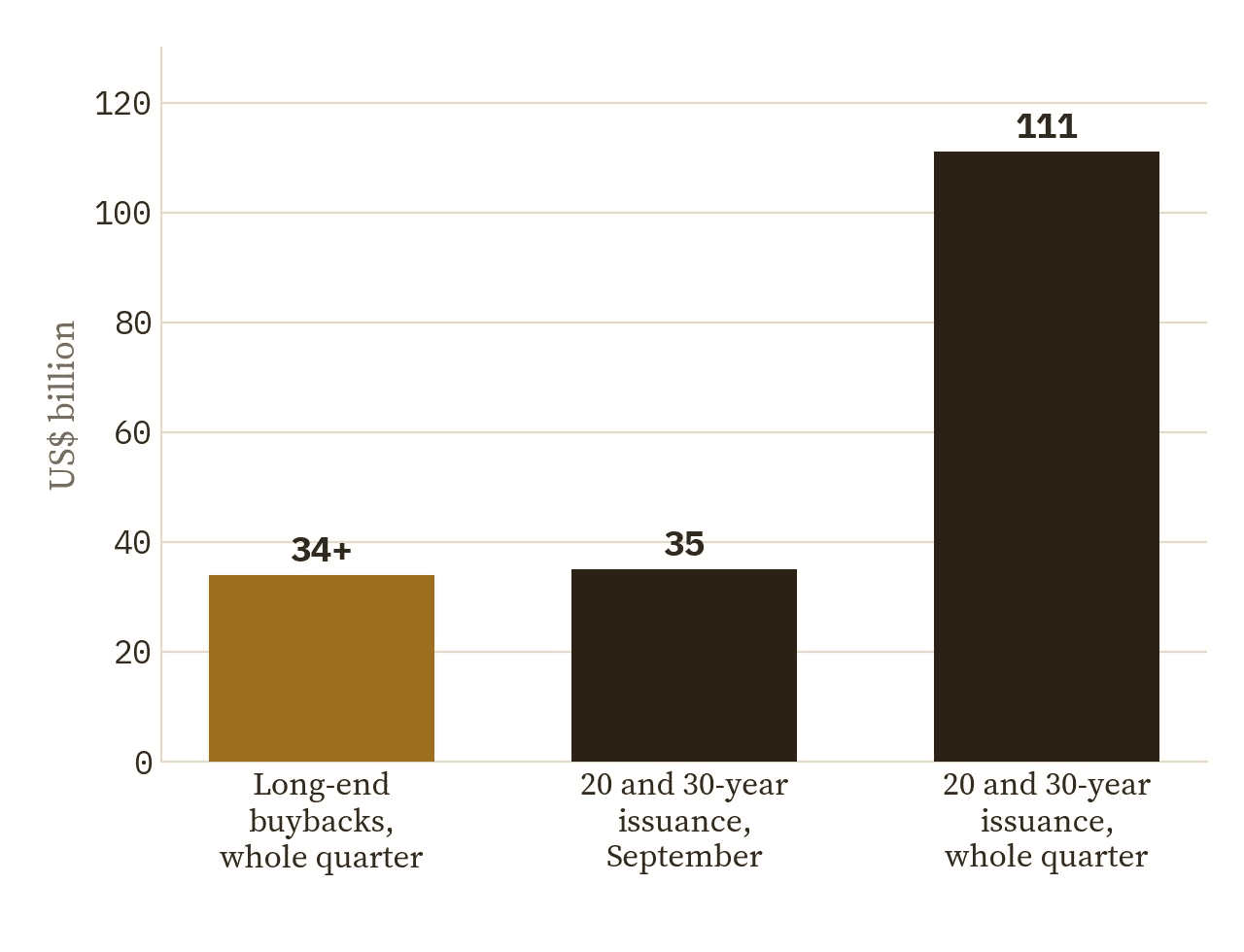
We believe five forces are doing the work: government deficits, the sheer volume of long-dated bond sales, five years of inflation running above target, a surge in borrowing to fund artificial intelligence infrastructure, and weaker demand from the buyers who used to absorb duration without asking questions. Foreign central banks and governments now hold only about 12% of marketable US Treasuries, and Treasuries have lost ground to gold as a share of the world’s reserve assets, though mostly because gold’s price has risen. The interventions have not helped. In August the US Treasury doubled its buybacks of 10 to 30-year bonds, which the market expects to be funded with short-dated bills. Between late July and late August Tokyo spent a record 15.4 trillion yen defending its currency. Washington is now managing the price of its own long bond and Tokyo the price of its currency, and the market has not been reassured.
Global liquidity is being absorbed by the real economy
Global liquidity is not collapsing. It has stopped growing. The Federal Reserve’s balance sheet has held at about 6.75 trillion dollars since it paused its bill purchases in August, quantitative tightening ended last December, and the Fed, the European Central Bank and the Bank of Japan are all raising rates. That alone makes 2026 a tighter year than the last few.
The less discussed part is where the money is going. Spending in the real economy is now absorbing capital that through the past decade would have sat in financial assets: the artificial intelligence build-out, energy security programmes after the disruption at the Strait of Hormuz, defence, and the rebuilding of inventories that the supply shock has drawn down. Observed global oil inventories alone are down roughly 507 million barrels since late February, according to the International Energy Agency. Money which was bidding for financial assets is being spent on steel, turbines, transformers and tankers. This is why we think financial conditions can tighten while nominal growth stays firm, and why we do not treat the September rate rises as the end of the tightening.
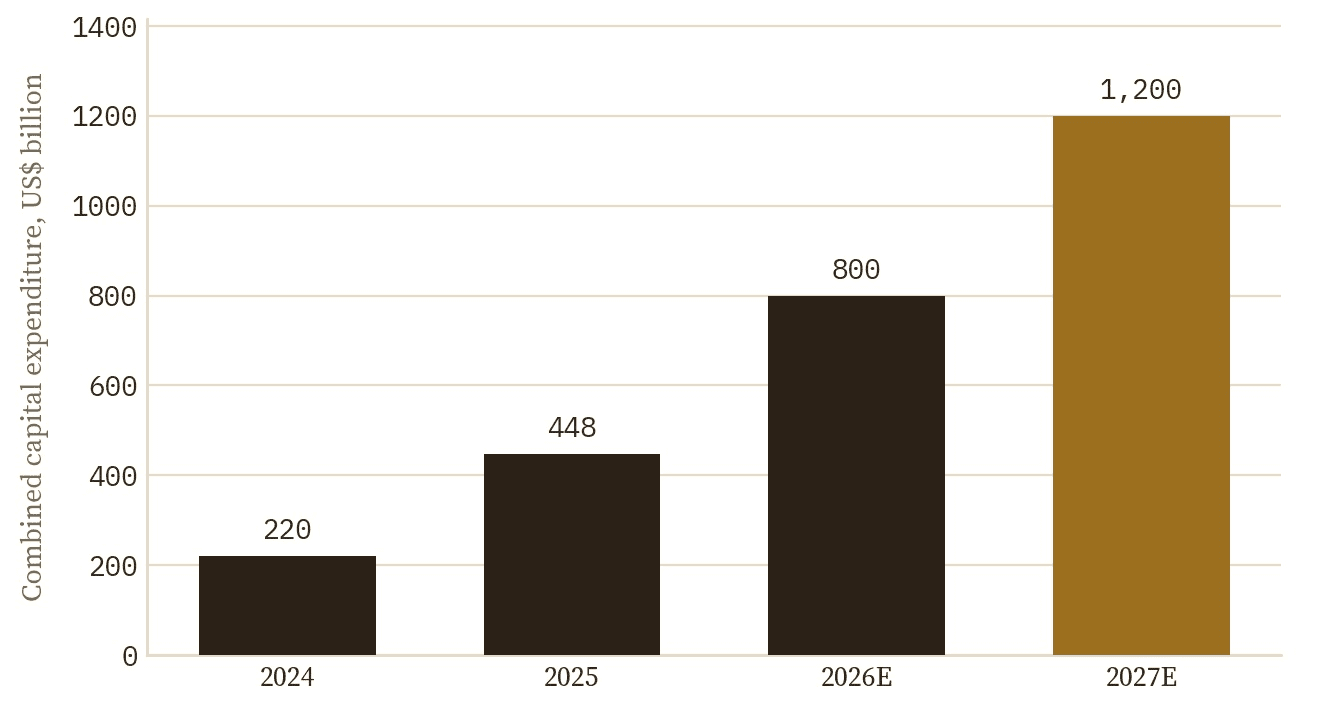
Spending on artificial intelligence keeps rising in absolute terms. Goldman Sachs puts capital expenditure by the large cloud companies at roughly 800 billion dollars this year and 1.2 trillion in 2027. What has changed is how it is paid for. On Goldman’s July estimates, the debt-funded share rises from about a quarter in 2025 towards 35% by 2027, which puts these companies in direct competition with governments for the same pool of savings. Credit markets have begun to charge for it: artificial intelligence related issuance now accounts for roughly 40% of investment grade supply at maturities beyond 15 years, and buyers now demand up to 20 basis points of extra yield on new deals, against 2 to 3 earlier this year.
Our view is that the growth rate peaks in 2027 even as the absolute number keeps climbing. On the other hand, spending on energy security, defence, grid and power generation is set by policy, contracted years ahead, and far less sensitive to the cost of money. It survives a repricing of artificial intelligence credit and it survives higher rates. That is where we would rather own the shovels, and it is where about a third of your capital sits.
Japan has stopped buying American bonds
The gap between the Federal Reserve’s policy rate and the Bank of Japan’s is about 2.6 percentage points. That gap is roughly what it costs a Japanese institution to hedge a dollar bond back into yen. At the long end, a 10-year US Treasury at about 5.2% therefore returns roughly 2.6% or less once hedged, while a 10-year Japanese government bond returns about 3.1%, with no currency risk at all. At these levels there is no reason for hedged Japanese money to own US Treasuries. Japan’s holdings have already fallen from about 1,239 billion dollars in February to about 1,104 billion at the end of July. A large and reliable buyer of duration has withdrawn on pure return grounds, and no amount of currency intervention changes that arithmetic. Only a narrower policy gap would.
Where we see this playing out
We see three ways this plays out if yields stay high. The probabilities we assign are judgements, not the output of a model.
A bond market accident followed by financial repression (45%)
A bond market accident could come from anywhere: a Treasury cash rebuild meeting a drained reverse repo facility, a failed French budget, forced selling of gilts by British pension funds, rising delinquencies in US commercial property, or a Japanese institution capitulating on duration. None of these is Indian, and that is the point worth making: an accident abroad reaches your fund through flows and sentiment, not through the solvency of what you own.
In this scenario, long yields spike first and then collapse as the Federal Reserve is forced to intervene. It will not be called quantitative easing. It will be called reserve management, or market functioning, and the effect will be the same. Equities would suffer a sharp drawdown, with an eventual recovery as the Fed intervenes and the dollar falls. Financial repression, in other words: the state caps the cost of its own borrowing and lets the savers pay for it. This is the scenario our cash is held for.
Stagflation-lite and a policy cap (40%)
Oil holds a high range, the Federal Reserve delivers one more increase and stops, and long yields grind sideways at uncomfortable levels while Washington and Tokyo keep improvising. Equities de-rate on multiples rather than earnings. The destination is the same as the first scenario, but reached slowly and without a panic.
Peace and an oil glut (15%)
A compromise on the Strait of Hormuz, most plausibly after the US midterm elections on 3 November, when the domestic political cost of a deal falls. Brent takes an initial knock and grinds lower through 2027 as shut-in Gulf barrels return. Front-end yields fall hard as the case for further tightening evaporates, the curve steepens and the long end falls least. This is comfortably the best outcome for markets.
The common thread is that the path to materially lower long yields runs through either cheaper oil or more central bank buying. Cheaper oil would be very good for India. More central bank buying debases the currency it is printed in, and favours real assets and businesses that generate cash rather than consume it. The middle scenario, the one we think most likely after the first, delivers neither. So the more useful question is not which of the three arrives, but what survives all three. We own businesses of the second kind, we own them with little debt, and in most cases we have not paid a multiple that requires the friendly outcome to happen. The exceptions are a few names bought on depressed earnings.
Holdings referenced form part of the Pegasus Growth Fund I portfolio and are discussed here for our investors. This is not investment advice.
Thank you for your continued trust and support.
Sincerely,
Team Pegasus