
Q1 FY27
Letter to Investors — June 2026
July 6, 2026
Dear Investors,
The generation of investors who mostly arrived after Covid has spent the last two years getting disillusioned. First with the index, then more painfully with everything outside it. The primary reason: inability to tell price from value. The Nifty 50 and Nifty 500’s performance of -1.1% and +1.4% over the last two years has unwound a lot of excesses from the market barring select pockets. Fortunately for us, this is happening at a time when there is more macro clarity than there has been since the beginning of Trump’s presidency. Also, a sideways market is a trader’s nightmare but a stock picker’s dream. For a long-term investor, it provides a great opportunity to turn more stones, assign a value, and wait for the price.
We do not know when the Indian indices will break their current range-bound phase. What we do know is that two of the three factors behind it may be reaching exhaustion. The first is FPI selling, even as the rupee remains the worst-performing major Asian currency: outflows crossed US$33bn in the first half of 2026, against US$18.5bn in all of 2025. The second is the rebalancing away from AI-disrupted IT services stocks. The IT services pack is now trading at a five-year low, and its weight in the Nifty, at 7.4%, is less than half of what it was five years ago. The third — when and where the AI bubble, now pulling in capital worldwide, finally bursts — we do not know, and we have stopped pretending anyone does.
For the last two years we have prioritised preservation, waiting for the kind of opportunity that lets us buy and hold rather than rent. We believe the outcome of the Iran war has provided significant clarity on global geopolitics going forward, and the realignment of global trade in the tariff era is beginning to take hold and, more importantly, looks to be in India’s favour.
During the quarter we continued to build on the manufacturing theme, initiating positions in three more manufacturing businesses that are picks and shovels positioned inside structural trends. We also exited our investment in IndiaMART InterMESH given the uncertainty around search as it evolves from a reactive list of blue links into proactive, conversational AI agents. Manufacturing now accounts for over 90% of your capital. The only two service holdings are Dynacons Systems (a system integrator benefiting from data centre implementation) and Engineers India, an engineering consultancy that faces little or no disruption from AI.
Our Focus on Industrials
Our manufacturing focus is not a tactical bet on a good year. It rests on six structural forces, and they tell us where to look while our process decides what we actually own.
Currency. The rupee has slid from the low 80s to the mid-90s against the dollar in two years, roughly 14%, a quiet and persistent competitiveness subsidy for exporters and import-substituters. More importantly, this comes against the backdrop of a stronger Chinese yuan against the dollar (the rupee is down about 18% against the yuan).
Trade realignment. A widening web of trade agreements (EU, UK, EFTA and more) is lowering the entry barriers for Indian goods into premium markets.
AI’s split screen. AI is hollowing out parts of IT services even as manufacturing keeps growing.
Talent turning to hardware. As software roles automate, India’s best engineers are moving into semiconductors, hardware, and industrial automation.
China’s anti-involution. Beijing is mandating an end to its overcapacity price wars, opening room for Indian manufacturers to compete on a level field.
Demographics. A young, growing workforce against the aging populations of China and the developed world.
The Backdrop, in the Data
A sideways market has hidden an economy that, underneath, is still expanding. Three things stand out in the data this quarter. Factory activity has held up through a genuinely hard external run, bank credit has broadened and accelerated, and the two external swing factors for India — oil and the monsoon — are now pulling in opposite directions.
Activity Has Held Up
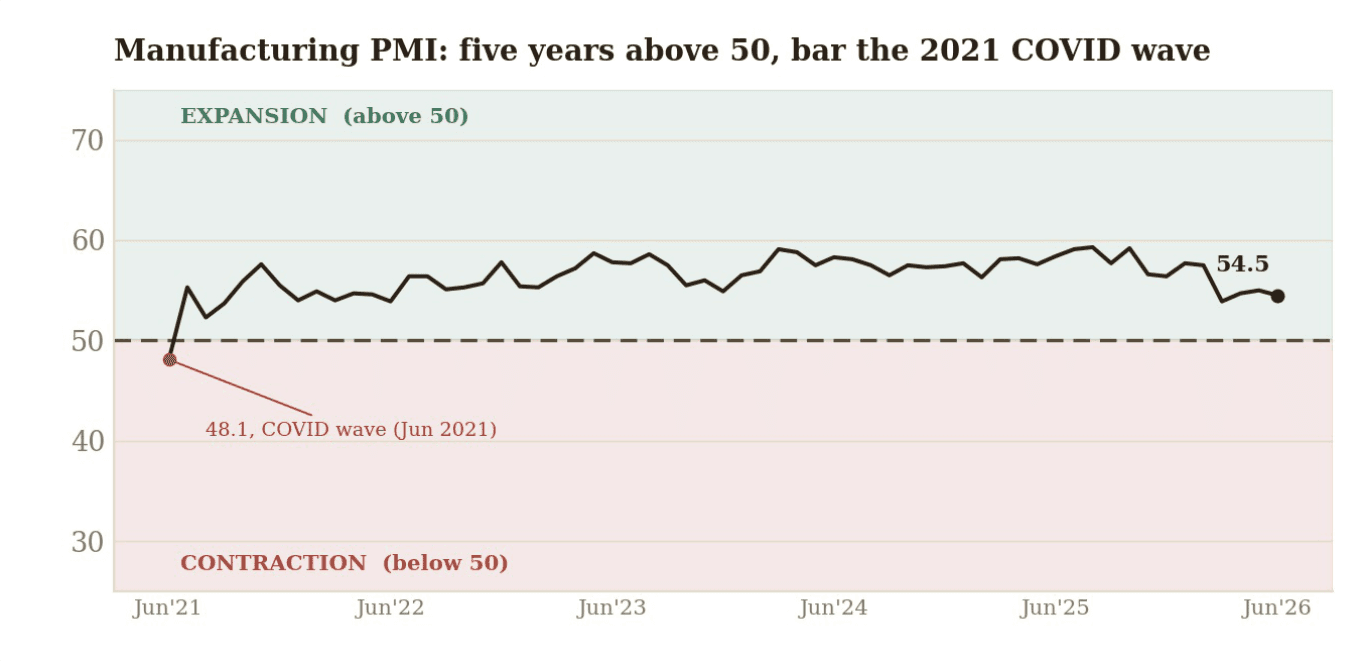
The manufacturing PMI has stayed above 50, the line between expansion and contraction, every month for five years save one. It softened this year as the cost and demand shocks landed, but firmly remained in expansion through a year that brought a US tariff on Indian goods as high as 50% (negotiated down to 18% in February) and a shooting war in the Gulf that started in late February.
Credit Growth Has Accelerated
The financing stage of the capex cycle is where the turn is clearest. Credit growth slowed through 2024 and bottomed around the middle of 2025, partly held down by a regulatory tightening on unsecured and NBFC lending. It has since turned up sharply and across the board. Non-food bank credit grew 15.8% in the year to April against 9.8% a year earlier. Credit to industry has climbed from 7.0% to 15.1%, and services from 10.1% to 18.6%, with every major sector now back in double digits.
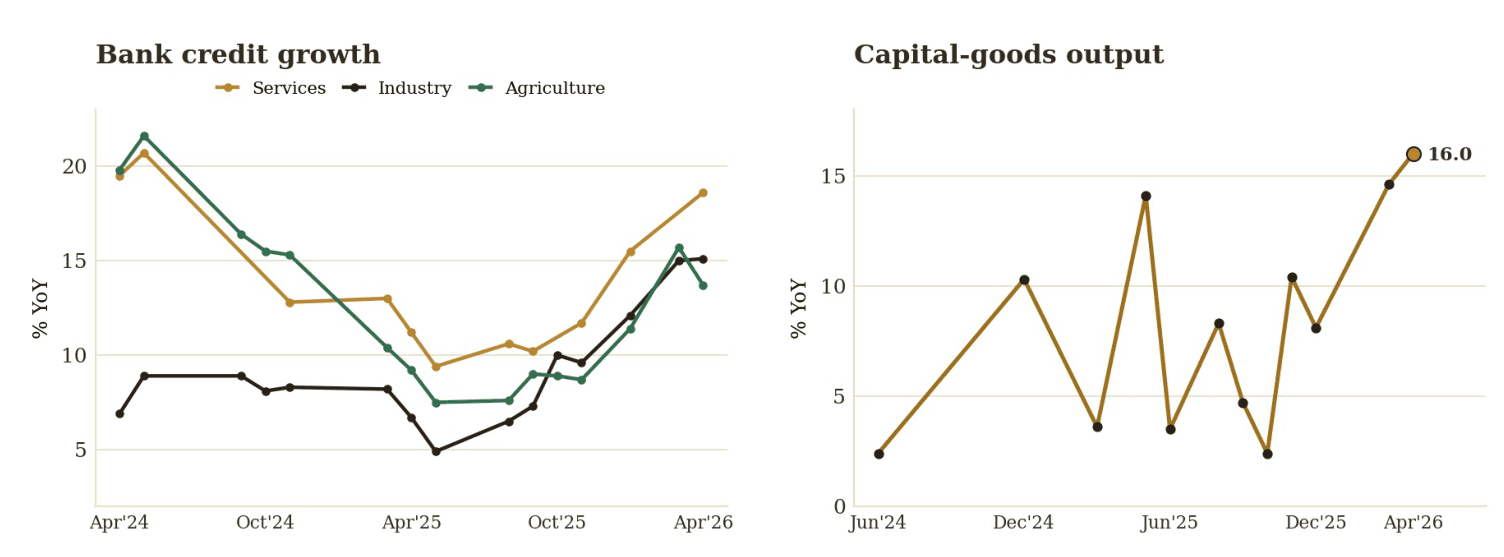
Capital-goods output, the cleanest proxy for machines being built, rose about 16% in April, infrastructure goods about 7%, and capacity utilisation sits near 75% — the level at which firms have historically had to add new lines.
Fuel Prices Have Reversed; the Monsoon Is a Monitorable
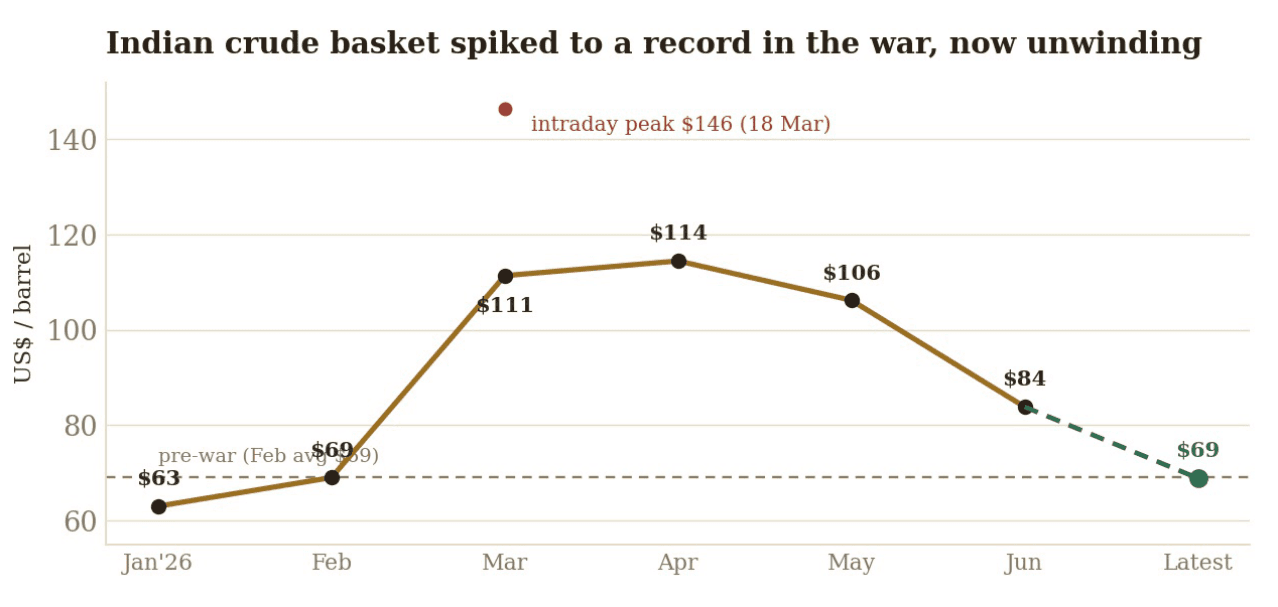
The biggest external shock of the quarter was oil, and it is now reversing. The Indian basket is about four-fifths Middle Eastern sour crude, so it moves harder than Brent whenever the Gulf is disrupted. When the Strait of Hormuz came under threat, the basket ran from a January average of $63 a barrel to an average of $114 in April. It has since unwound. The latest daily prints are back near $69, roughly where they began, as the truce held and Hormuz traffic normalised. The headline basket also overstates India’s true cost, because close to a third of imports are still discounted Russian crude.
Pulling the other way is the weather. The Pacific crossed into El Niño by June, and NOAA has flagged the risk of a strong event into early 2027. The IMD has put the 2026 monsoon at around 90% of the long-period average, and the June rainfall deficit was more than 40%. El Niño years tend to suppress the monsoon, and roughly 60% of Indian farmers depend on it for the Kharif crop. While oil rolling over is the disinflationary force, an erratic monsoon poses an upside risk to inflation. July is when the season is usually decided, and we are watching it closely.
Portfolio: The Themes and the Shovels Beneath Them
During the quarter, we started building three new positions in the manufacturing space, with capital coming from top-slicing some overweight positions. We summarise below our top holdings and the structural trends behind them.
Shivalik Bimetal Controls — The Electric Transition
The shovel is current sensing and circuit protection — shunts and bimetals — acquired at roughly 27x earnings on a 27% ROCE with a net-cash balance sheet. Shivalik makes the tiny precision components that let a circuit measure and survive electric current: thermostatic bimetals that bend with heat to trip a breaker, low-ohmic shunt resistors that sense exactly how much current is flowing, and electrical contacts. The real business is not the parts, it is the metallurgical joining behind them — fusing dissimilar metals through diffusion bonding, electron beam welding and cladding to tolerances that take a customer one to two years to qualify and then cannot easily be replaced. That is the moat: a 77-grade bimetal recipe library built over four decades, in-house electron beam welding machines the company builds itself at roughly half the cost and a quarter of the lead time of buying them, and roughly 90% of India’s thermostatic bimetal market with about 16% globally.
The electric transition runs straight through the shunt business. Every battery management system in an EV needs accurate current sensing, as does every smart meter India is mandated to install, and Shivalik supplies the precision shunts that do it, selling to a roster that runs from Siemens, ABB and Schneider to Tesla, BYD and Tata across more than 300 OEMs in 38 countries. The next leg is forward integration: a new Pune facility moves the company from selling metal strips to selling finished busbars and welded assemblies, raising the value captured per unit.
What we’re watching: customer concentration is the real risk — Vishay alone takes roughly 40% of shunt revenue, so any slowdown in their programmes hits the top line directly. Manufacturing is also concentrated at a single site at Solan, and after a strong run the valuation leaves less room for error.
Himadri Speciality Chemical — Batteries & Energy Storage
The shovel is cell active materials — LFP cathode, anode and advanced carbon — acquired at roughly 31x earnings on a ~34% ROCE with a net-cash balance sheet. Himadri started as India’s largest coal tar pitch maker and has spent the last few years climbing the value chain into specialty carbon black and, most importantly, the materials that go inside a lithium-ion cell. The base business is already excellent: essentially debt-free, ROCE around 34%, with five-year compounding of roughly 29% on revenue. That alone is a high-quality specialty chemicals compounder. The battery materials are the optionality stacked on top, and we are not paying much for them.
The centrepiece is India’s first commercial lithium iron phosphate (LFP) cathode plant, a 40,000 tonne first phase in Odisha targeted for FY27, inside a longer vision that scales toward 200,000 tonnes. Cathode active material is the single most valuable component of an LFP cell and today is overwhelmingly imported from China. We are buying the established, cash-generative carbon business at a reasonable multiple and getting the battery-materials build largely as a free option on India’s cell-manufacturing decade.
What we’re watching: the LFP build is large relative to current profit, so cost overruns, delays or soft demand from Indian cell makers would hurt, and the FY27 commissioning is the milestone to track. Chinese cathode producers are scaled and cheap. The core business stays cyclical, and working capital has stretched as capex ramps.
Ion Exchange (India) — Water Security & Green Hydrogen
The shovel is water treatment, resins and membranes — acquired at roughly 24x earnings on a 14% ROCE (currently depressed by a working-capital drag) with modest net debt. Ion Exchange is India’s pioneer in water and environment solutions, spanning the full cycle from process and wastewater treatment to zero-liquid discharge, desalination and packaged drinking water. The business runs across three segments: engineering (the EPC plants, about 61% of revenue), chemicals (resins and specialty chemicals, about 29%, and the highest-margin piece), and consumer products (purifiers, about 10%). Water scarcity, groundwater depletion, tightening industrial norms and now green hydrogen all pull demand the same way, and Ion Exchange sits at the technology end with resins and membranes that are hard to replicate.
The last two years have been rough for Ion Exchange. Legacy EPC projects distorted margins and stretched working capital, and FY26 profits fell even as revenue grew. The catalyst we are buying is the turn: a new greenfield resin plant at Roha is commissioning in stages, a membrane partnership with MANN+HUMMEL deepens the high-margin chemicals leg, and management has tightened order selection.
What we’re watching: margins and cash are the whole question. FY26 EBITDA fell about 29%, dragged by low-margin legacy projects and a loss-making consumer division, and working capital is heavy with receivables rising faster than sales. Management itself says the worst is not entirely behind them, so FY27 is the proof point.
Dynacons Systems & Solutions — Data Centres & Digital Infrastructure
The shovel is IT infrastructure system integration — acquired at roughly 13x earnings on a 30% ROCE with modest net debt. Dynacons is an IT infrastructure and digital-transformation company across data center and cloud, network and cybersecurity, digital workplace, and managed services. It wins, deploys and then runs mission-critical IT for heavily regulated customers, with marquee contracts from the RBI, SBI, LIC and others. The economics are quietly transforming: EBITDA margin has climbed from roughly 4% in FY21 to about 10% in FY26 as the mix shifts from one-off hardware toward recurring managed services. The May 2026 order book of over ₹3,000 cr is close to two years of revenue, on top of a ₹5,100 cr bidding pipeline. This was an early Pegasus call due to valuation and capital efficiency. We are honest that the moat here is execution and relationships, not a structural monopoly, and we size it accordingly.
What we’re watching: margins and cash. Q4 profit grew far slower than revenue, so margin sustainability as it scales is the central question. Net debt and working capital have risen with the order book. It is a competitive, relationship-driven business, and the stock has been volatile after a sharp run.
In Focus — The New Fuels
India imports most of the energy it consumes: more than half its natural gas, nearly all its ammonia, most of its methanol and the bulk of its crude — all of this while holding some 400 billion tonnes of coal, which it is under growing pressure not to burn. The war in the Persian Gulf, a depreciating currency and an increasingly multipolar world have brought energy security to the top of its strategic priorities. The policy answer is not a single fuel but a basket: coal converted to gas rather than burned, nuclear capacity raised roughly twelve-fold, and hydrogen made from water. The team at Pegasus has spent much of this year working out where in that build an asset manager is actually paid, and the answer is rarely the fuel itself.
Coal gasification. Gasification cooks coal under heat and pressure into syngas, the building block for ammonia, methanol, urea, synthetic natural gas and hydrogen — all of which India imports in volume. The government reset the programme in 2026 with a scheme of roughly ₹37,500 crore, on top of the ₹8,500 crore version from 2024, funding up to a fifth of plant-and-machinery cost. Orders have started to appear: BHEL won a ₹5,400 crore award for the Lakhanpur plant in early 2026, and Adani is planning a ₹70,000 crore syngas complex near Nagpur. The capital sits in three blocks: the gasifier vessel, the air-separation unit and downstream synthesis, with piping, refractories and water treatment around them. On the smile curve we prefer the air-separation unit, because the gas majors own and operate it on the customer’s fence and sell the oxygen on long take-or-pay contracts — an annuity rather than a one-time build. The refractory that relines the gasifier and the catalyst in the synthesis loop are the other recurring seats we like.
Nuclear: Small Modular Reactors. The Kalpakkam fast breeder reached first criticality in April 2026, moving India into the second stage of its fuel cycle and, in time, toward its large thorium reserves. India mines about 600 tonnes of uranium a year, one to two percent of world output, so fuel supply limits the pace until the breeder-and-thorium cycle scales. The SHANTI Bill, passed in late 2025, amended the Atomic Energy Act and the nuclear liability law to admit private capital to the sector. Six major houses — among them Reliance, Adani, Tata Power and JSW — have applied to build captive Bharat Small Reactors. In nuclear, the moat is certification rather than a licence. The value sits in the certified population that recurs for decades: nuclear-grade valves, pumps, seals and instrumentation carrying ASME III or N-stamp and AERB approval, plus fuel, refuelling and life-extension work. Best placed is therefore the certified critical-component maker with an aftermarket, not the island builder.
Hydrogen. The Indian Green Hydrogen Mission targets 5 million tonnes a year of green hydrogen by 2030, with about ₹19,744 crore of support and 125 GW of dedicated renewables behind it. The SIGHT scheme has already allocated electrolyser manufacturing and production capacity across a range of firms, and the cost evidence is encouraging: SECI’s green-ammonia auction cleared at ₹50 to ₹65 a kilo against a global benchmark near ₹110. The electrolyser stack (membrane, electrode, PGM catalyst) is mostly imported IP, and the stack itself is heading into a price war globally. So the durable value is not the stack but the recurring layer around and inside it: the catalyst-coated membrane, which degrades and is re-bought; the enabling hardware of seals, valves, compressors and power electronics; and the ultrapure water feed.
One Opportunity Across Three Fuels
We have little interest in owning the plant, the reactor or the electrolyser. Each is capital-intensive and policy-dependent, and the returns accrue to the cheapest balance sheet, which in India means Reliance, Adani, NTPC and the public sector. Our preference is the supplier one layer back, and specifically the supplier paid at the right point in a project’s life. Projects of this kind pass through four stages: first it is designed (feasibility, front-end engineering, process design, project management); then it is built by an EPC contractor; then it is equipped (the gasifier vessel, the air-separation unit, the reactor forgings, the pumps, the seals, the refractory lining and the storage); then, for decades, it is maintained on replacement consumables. Most investors concentrate on the middle stages, where the orders are largest and the announcements land. We would rather hold the first. The design house is paid before financial close and before execution risk is taken, its fee is a small share of project cost but carries high margin and almost no capital, and because it touches every project at feasibility it sees the whole pipeline before the money is committed. It is the closest thing in this cycle to a leading indicator one can own.
Engineers India
The position in our books that expresses all three fuels at once is Engineers India. It is the country’s oldest hydrocarbon design and project-management consultancy, a Navratna with a net-cash balance sheet, doing precisely the first-stage work described above. For most of its history that meant refineries and petrochemicals. What has changed is that the same design capability is now being directed at the new fuels: the company has been engaged on project management for coal gasification, is developing green-hydrogen and bio-refinery work, and in August 2025 signed an agreement with NPCIL to provide the engineering for the Bharat Small Modular Reactor.
We hold the position because the quality of the business and its place at the front of a multi-decade capital cycle are both evident today. At about 17x earnings (at the time of acquisition) on a return on capital near 30%, we judge the price fair rather than cheap. If the new fuels disappoint on timing, as some will, we are left owning the best-placed design house in the country at a sensible multiple. That is a holding we are comfortable owning early.
Holdings referenced form part of the Pegasus Growth Fund I portfolio and are discussed here for our investors. This is not investment advice.
Thank you for your continued trust and support.
Sincerely,
Team Pegasus