
Q3 FY25
Letter to Investors — January 2025
January 13, 2025
Dear Investors,
A little over a year ago, as we embarked on our investment journey, the markets were experiencing one of the sharpest year-end rallies — the Nifty was up 14% between October and December. This, coupled with heightened euphoria in many segments, called for significant caution. In an overheated market, great opportunities are not absent — they are just harder to spot. Your fund became fully invested only by March 2024 and delivered a return of 28% in its inaugural year.
The Nifty’s 9% return in 2024, in our view, was commendable, especially following a blockbuster 2023 and a mid-single-digit earnings growth among its constituents year-to-date, besides a weaker-than-expected election mandate for the BJP and a global realignment of assets away from India — resulting in the largest-ever foreign institutional selling in the secondary market in a year (US$34bn).
Your fund saw a higher-than-average realignment of portfolio during the first year, with six exits making way for a more defensive portfolio by the year end. We expect 2025 to be a year of volatility with the possibility of another round of unwind in the Yen carry trade. This, coupled with inward-looking policies in the US, Trump rhetoric and an overheated US equity market, could see good opportunities emerge during the year.
How Passive Is Your Portfolio?
I recently met with a client — an extremely conservative investor — who had, after years of contemplation, added equity to his portfolio. He invested passively in an index fund in 2021 and earned a CAGR of 25% over three years, nearly doubling his total portfolio yield to 15%. While his timing was impeccable, what concerned me was his belief that a combination of index funds and bonds would continue to provide him ‘consistent’ 15% returns.
A similar instance occurred in 2007, when I met with an investor in the US hedge fund I worked with. Despite appreciating the fund’s outperformance over the Nifty, he felt we would be better off running an unhedged long on the Nifty and accepting slightly lower returns instead of actively managing a portfolio. In hindsight, he may have seemed right; the Nifty had tripled in the previous three years, and active managers like me struggled to clinch a few percentage points of outperformance. Human beings tend to anchor expectations based on recent successes. Back in 2007, the Nifty, which peaked at ~6100 in December, took eight years to break out of this high (early 2014). An investor in passive index funds would have earned negative real returns over those eight years.
Distinguishing Past Performance from Future Fundamentals
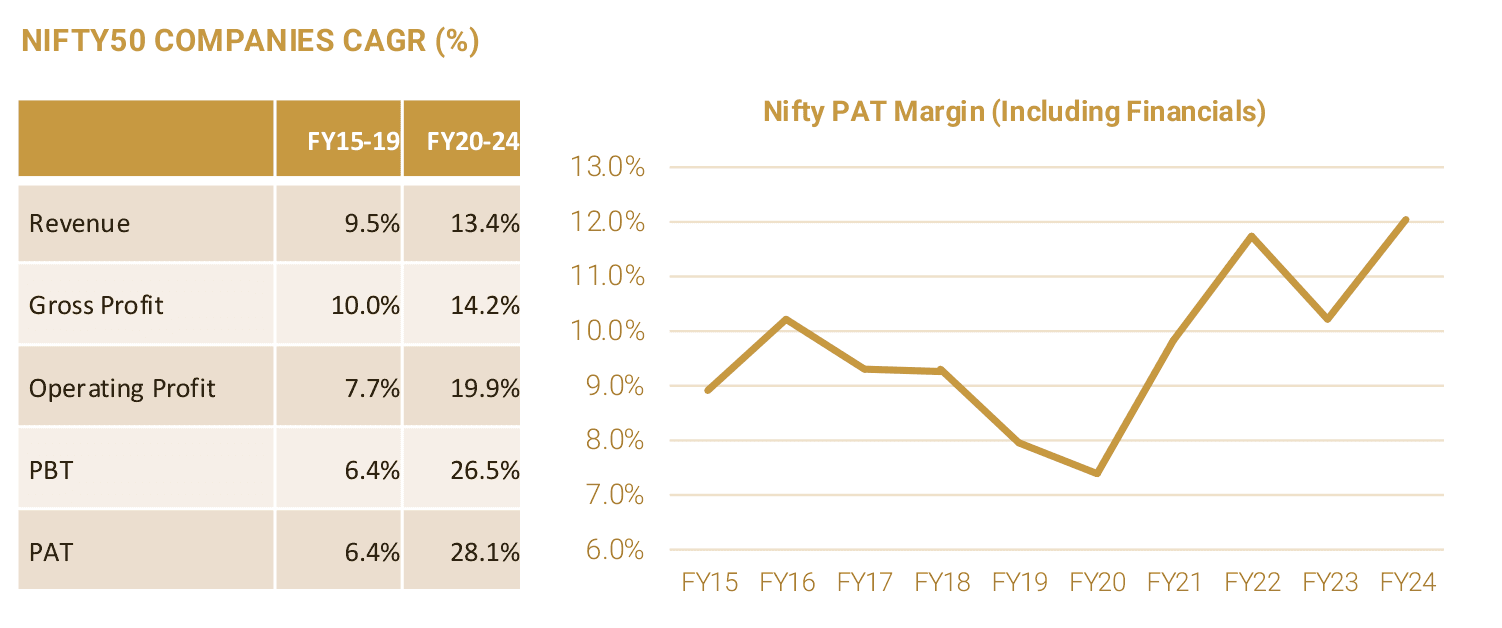
In our April 2024 letter, we discussed in detail how the margin expansion phase in Nifty companies was behind us. From FY20–24, while Nifty50 topline growth averaged 14% CAGR, profit growth was double that at 28%. Net profit margins rose from 7.4% to 12.1% in four years — a level last seen in FY08 (pre-GFC).
While a small part of this can be attributed to index reconstitution, much came from operating and financial leverage. Pre-pandemic, companies prioritized deleveraging over capex. Post-COVID, multiple factors supported profits — global dislocations boosted gross margins, stagnant fixed costs expanded operating margins, lower lending rates reduced finance costs, and the new tax regime cut tax outflows. Additionally, topline growth was boosted by post-pandemic YOLO consumption and a surge in personal loans by finance companies — both of which have since receded.
Where Can the Index Go from Here?
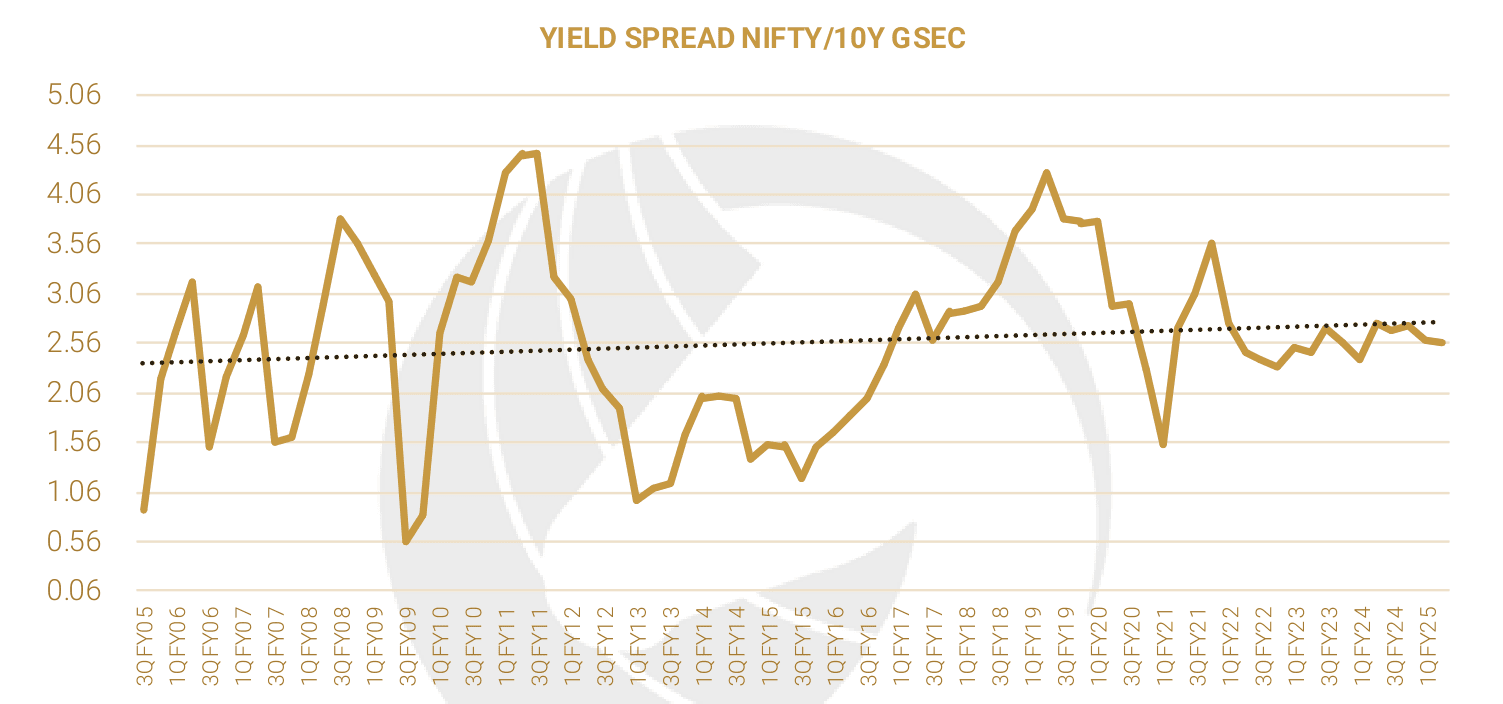
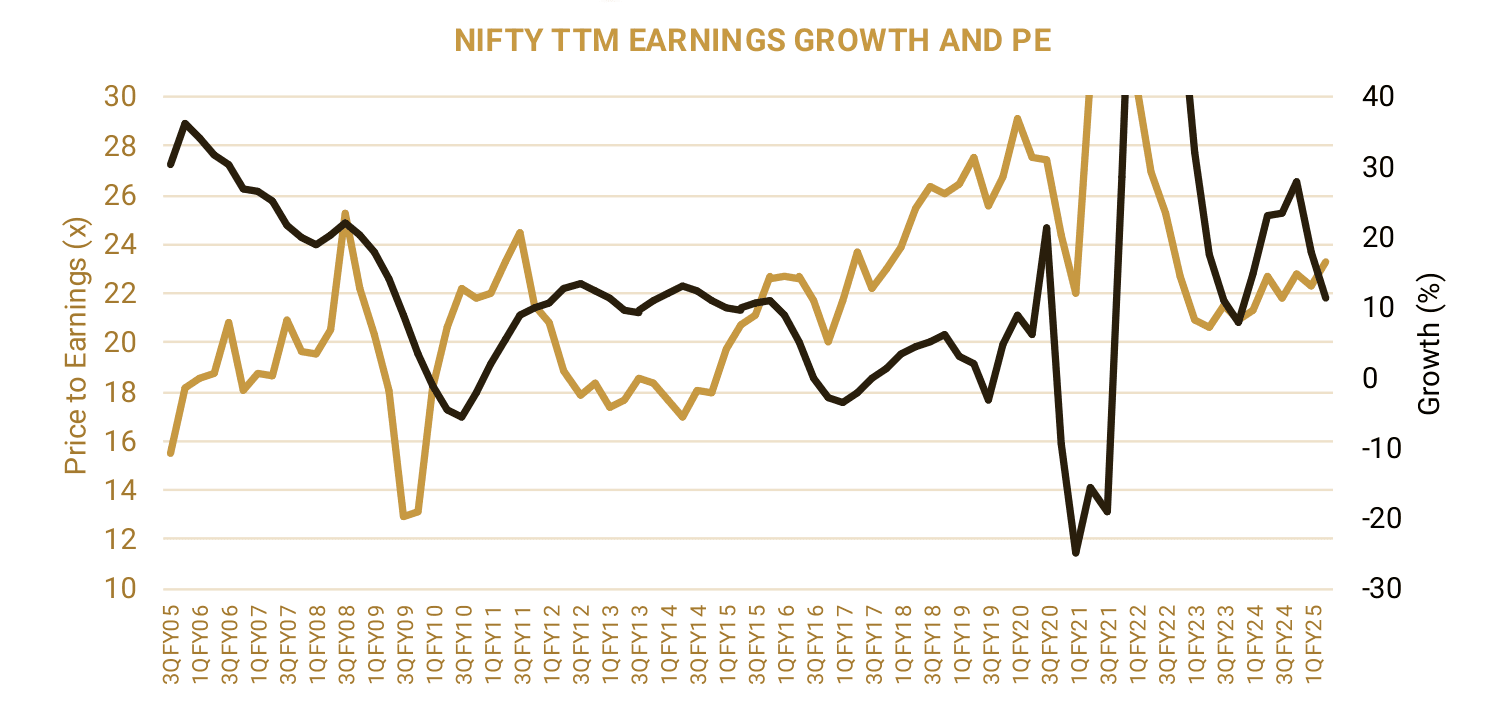
Looking ahead, the three broad variables that will determine the benchmark’s performance are Revenue Growth, Margin Expansion/Contraction, and PE Expansion/Contraction. With capacity utilization across large companies at high levels, there is a gradual shift toward capacity expansion and workforce growth. As expected during investment phases, operating leverage turns negative, leading to margin compression. Additionally, valuation expansion may not be a reliable driver of returns, as earnings yield spreads relative to long bond yields are in line with historical averages. Betting on rerating would require a global liquidity boost. This leaves revenue growth to do the heavy lifting.
Also as highlighted in our October 2024 letter, structural changes in the business landscape point to increasing competitive intensity for large companies. Small and mid-sized companies now benefit from easier access to capital (SME exchanges, venture funding), easier access to markets (e-commerce platforms), cost-effective and scalable marketing tools (AI-driven strategies on social media), and favourable demographics.
Recent consolidated revenue growth for Nifty constituents has been in the single digits for two consecutive quarters, albeit with potential to revert to early-teens in the second half of the financial year. We believe the outcomes of passive investment strategies in recent years may be difficult to replicate, and foresee the market consolidating within a broad range over the next two years.
Thank you for your continued trust and support.
Sincerely,
Team Pegasus